How to Specify Pad-Mounted Transformer Sound Levels in an RFQ
Published July 22, 2026 · Prepared by the TransformerGrid technical editorial team · Project-specific requirements require manufacturer, utility and applicable-standard verification.
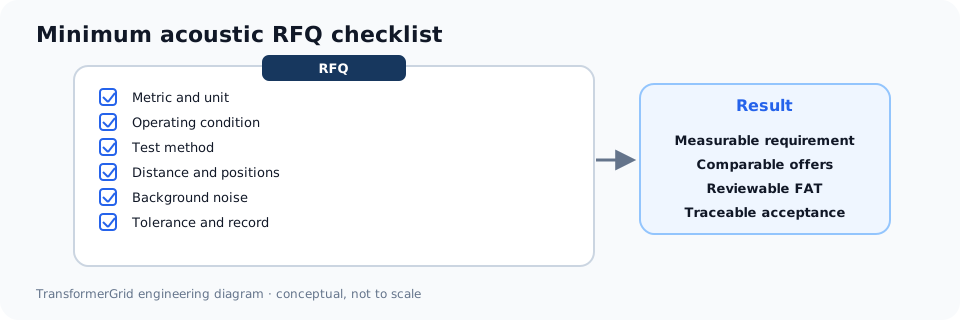
The two most dangerous acoustic words in an RFQ may be “low noise.” They allow the buyer to believe a requirement exists and the bidder to price a standard design. The disagreement appears only after design release—or after energization.
The eight fields an enforceable clause needs
- Transformer type, rating, voltage, phase, frequency and cooling arrangement.
- Governing acoustic test standard and edition.
- Required quantity: average A-weighted sound pressure, sound power, octave-band data, or a defined combination.
- Operating condition: no-load, rated voltage/frequency, tap position, load and cooling status as applicable.
- Measurement contour, distance, microphone locations and height.
- Background-noise and environmental-reflection treatment.
- Required raw data, instrument/calibration information, photographs and report format.
- Separate ownership of factory equipment performance and site/property-line compliance.
North American projects may incorporate IEEE, NEMA and utility requirements. International projects commonly reference IEC 60076-10. A standard name must match its scope and the contract edition. A factory equipment value is not automatically the same as a municipal property-line limit.
Put the requirement where deviations cannot disappear
TransformerGrid places the clause in the RFQ schedule and special requirements, then records the manufacturer’s compliance, exceptions and required inputs. The same line is carried into the approved specification, drawing review and FAT documentation. If the buyer begins with “it must be quiet,” we ask about building use, receiver distance, day/night criteria, site plan and expected operating conditions before requesting a number.
| Weak wording | Review question | Traceable result |
|---|---|---|
| Low-noise design | Which quantity, standard and condition? | Named limit and method |
| Suitable near residences | Distance and local boundary criterion? | Equipment/site responsibilities |
| FAT report required | Which raw data and corrections? | Defined report schedule |
We do not win trust by promising every number before the design is checked. We win it by getting the achievable project-specific commitment into the file before the purchase order. See the full noise procurement workflow, then send your SLD and sound-sensitive site information for an RFQ gap review.