Pad-Mounted Transformer Noise: How to Specify Sound Limits, Review FAT Results and Avoid Site Complaints
Published July 22, 2026 · Prepared by the TransformerGrid technical editorial team · Project-specific requirements require manufacturer, utility and applicable-standard verification.
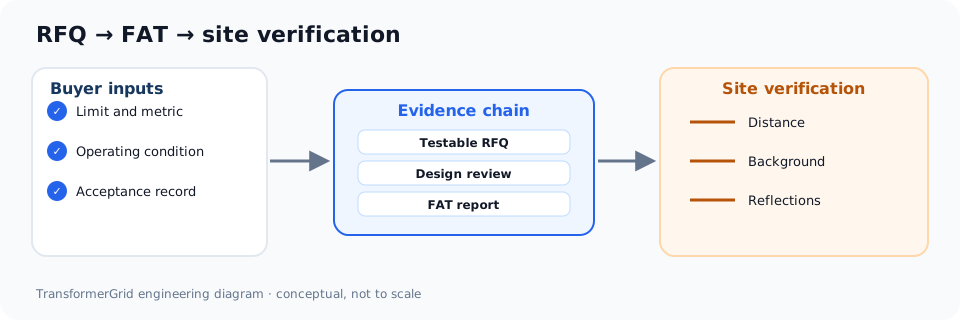
The most expensive transformer noise is often the requirement that was never written. A typical RFQ may define kVA, primary and secondary voltage, impedance, BIL, losses, fusing and delivery—and then finish with two words: “low noise.” Those words sound cautious but do not create an acceptance criterion. How low? Sound pressure or sound power? No-load or loaded? Cooling equipment on or off? At what measurement contour, with what background correction, and under which standard?
Composite-scenario notice: the people and events in this article cluster combine recurring procurement, engineering-review and site-coordination risks. They do not describe one named customer or a single actual order.
A factory report and a site complaint can both be honest because they answer different questions. A controlled factory test describes the unit under specified operating and acoustic conditions. A hotel, school, hospital, office campus or residential boundary asks what a receiver experiences after distance, walls, hard paving, foundations, voltage conditions, load harmonics and cooling equipment have altered the sound field.
Turn “low noise” into six verifiable decisions
- Separate the equipment sound requirement from the property-line or indoor requirement.
- Name the governing standard and edition, the acoustic quantity, weighting and operating condition.
- Review the site plan, foundation, reflecting surfaces and distance to the nearest sensitive receiver.
- Put the requirement in the RFQ and deviation schedule before design release—not in a late email.
- Agree on the FAT measurement contour, background treatment, instrument record and report format.
- If site verification is needed, use a comparable method and record electrical and environmental conditions.
What TransformerGrid adds before a purchase order
TransformerGrid does not use “quiet transformer” as a substitute for engineering. We translate the buyer’s application into traceable questions, coordinate the manufacturer’s design response, preserve deviations, and follow the same requirements through drawings, FAT documentation, production and delivery. That is a stronger promise than an attractive but undefined decibel number.
Our currently disclosed manufacturing partner, Jiangsu Yawei Transformer Co., Ltd., provides manufacturing, testing, certification and export evidence and offers three-phase pad-mounted transformer designs. Its public sample does not state one acoustic limit that applies to every rating. A responsible quotation therefore confirms sound performance for the actual kVA, voltage, frequency, loss target, cooling arrangement, enclosure and site requirement.
| Buyer sends | TransformerGrid organizes | Manufacturer confirms |
|---|---|---|
| SLD, ratings, frequency and site plan | Acoustic requirement and missing-data list | Design basis, exceptions and achievable test condition |
| Nearest receiver and local limit | Equipment/site responsibility boundary | FAT method and deliverables |
| Expected load and harmonic context | Comparable review record | Project-specific response |
RFQ wording pattern and responsibility boundary
A usable acoustic requirement separates the transformer’s factory-verifiable performance from the project’s receiver or property-boundary obligation. The parties should not treat one as automatic proof of the other.
| Contract item | Buyer or project input | Supplier and FAT evidence |
|---|---|---|
| Governing basis | Applicable standard, edition, utility requirement and local environmental criterion | Declared test method, scope and any deviation |
| Acoustic quantity | Sound pressure or sound power; weighting and octave-band needs | Guaranteed quantity and report units that match the requirement |
| Operating state | No-load, loaded condition, tap, voltage/frequency, cooling equipment and auxiliaries | Recorded test state and nameplate/design basis |
| Measurement conditions | Required contour or receiver locations, background treatment and reporting format | Instrument, calibration, positions, background data and corrected result |
| Site obligation | Nearest sensitive receiver, property-line limit, building use and day/night criterion | Equipment data needed by the project acoustic designer; no unsupported site guarantee |
| Acceptance record | Who reviews, when deviations are closed and what evidence releases shipment | Signed report, exception list and traceability to the approved specification |
Clause pattern—complete every bracket before issue: “The transformer shall be evaluated in accordance with [standard and edition]. The guaranteed acoustic quantity shall be [sound pressure or sound power], reported as [dB(A), unweighted level and/or octave bands] under [operating condition]. Measurements, background correction and reporting shall follow [method]. The supplier shall submit [report content] for approval. Compliance with a separate site or property-boundary criterion remains [named party’s responsibility] unless expressly included in the supplier’s scope.”
This pattern deliberately contains no universal decibel value. The correct number depends on rating, design, governing document, receiver sensitivity and project responsibility. A bidder should price only a completed requirement, not guess what “quiet” means.
Buyer input pack before quotation
- Transformer ratings, frequency, tap range, cooling mode and expected loading.
- Applicable standard editions, utility specification and any contractual hierarchy.
- Site plan showing the unit, walls, hard surfaces, buildings and nearest sensitive receiver.
- Local day/night or indoor acoustic criterion and the authority that applies it.
- Required factory report, witness point, calibration evidence and deviation process.
- Clear allocation of equipment performance, site mitigation and post-energization verification.
The five focused guides in this cluster
- Why a unit can pass FAT and still create a site dispute
- How to write an enforceable sound clause in the RFQ
- How to compare factory and site data correctly
- How the core, clamping and tank influence sound
- How distance, walls, pads and vibration paths change the result