Harmonics, Overexcitation and Load Conditions: Why Transformer Sound Changes
Published July 22, 2026 · Engineering coordination review by TransformerGrid · Project-specific requirements require manufacturer, utility and applicable-standard verification.
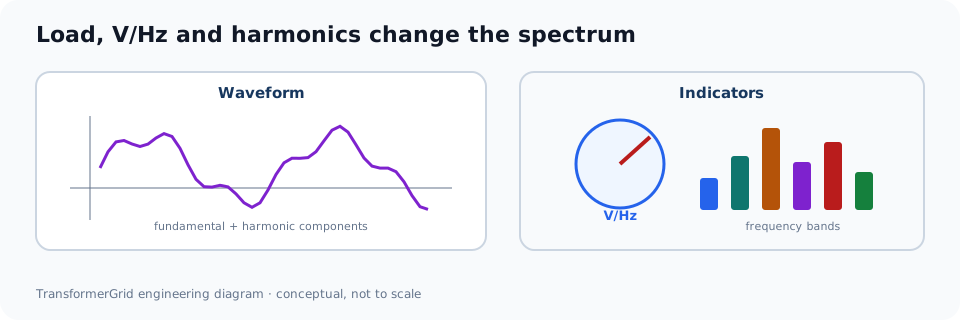
Transformer sound changes with electrical condition. A recording without simultaneous voltage, frequency and load data cannot reliably distinguish an expected operating change from an abnormal condition.
Overexcitation and V/Hz
Core flux is closely related to voltage divided by frequency. Higher voltage or lower frequency can raise flux, magnetizing current, loss, temperature and sound. Equipment designed for 50 Hz and 60 Hz is not interchangeable solely because the voltage is equal; the nameplate and design V/Hz must be respected.
Voltage and current harmonics
Voltage harmonics alter the flux waveform and acoustic frequency content. Current harmonics add load loss, heating and electromagnetic-force components. Inverters, drives, UPS systems and other nonlinear loads justify power-quality measurement; their presence alone does not prove an acoustic defect.
Load and unbalance
At no load, core contribution is prominent. With load, winding forces and cooling stages may become more important. Record kVA/current, power factor, phase unbalance, cooling status and temperature beside each sound or vibration sample.
Trend method
- Establish a baseline under repeatable conditions.
- Synchronize sound spectrum, vibration, voltage, current THD and temperature.
- Compare direction and timing of changes.
- Escalate when independent indicators deviate together.
A change in sound is a prompt to measure; it is not a diagnosis by itself. Return to the engineering guide.
Technical Questions and Engineering Discussion
To discuss harmonics, V/Hz, load and sound, contact [email protected]. Technical exchanges are welcome.
Primary engineering references
- IEC 60076-10:2016 — determination of transformer and reactor sound levels.
- IEC 60076-10-1:2016 and Amendment 1:2020 — application guidance.
- IEEE C57.136-2023 — sound and vibration guidance for liquid-immersed power transformers.
- NEMA TP 80050-2013 (R2024) — audible sound levels for distribution transformers.
Standards must be applied within their stated scope and the edition incorporated into the project documents. This page is an engineering reference, not a substitute for the governing contract, utility specification or safety procedure.