Why Transformers Hum: Magnetostriction, Electromagnetic Forces and Cooling Sources
Published July 22, 2026 · Engineering coordination review by TransformerGrid · Project-specific requirements require manufacturer, utility and applicable-standard verification.
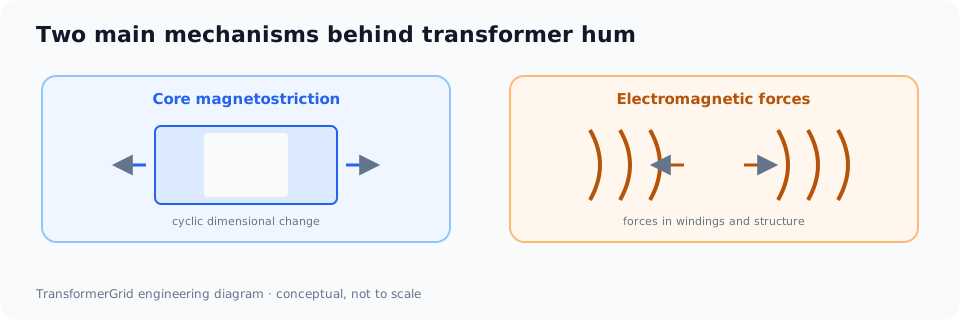
A transformer hum is produced by alternating electromagnetic fields and their mechanical transmission; no rotating machine is required for the basic phenomenon.
Magnetostriction
Core material changes dimensions by a very small amount as magnetic flux varies. The strain pattern commonly produces a strong component near twice system frequency—approximately 100 Hz at 50 Hz and 120 Hz at 60 Hz—plus higher harmonics. Flux density, steel grade, joints, assembly stress and clamping influence the emitted spectrum.
Electromagnetic forces
Load current and leakage flux act on windings, leads and support parts. Their force components can change with the square of current and with harmonic content, but measured behavior depends on the full structure. A louder loaded condition is a clue, not automatic proof of winding movement.
Cooling sources
Fans, pumps, bearings and airflow add sources that differ from core hum. The test or field record should state which stages were operating.
Structural radiation and resonance
The tank, radiators, panels, doors, attachments and foundation transfer vibration and radiate sound. A local part close to a natural frequency can amplify a narrow band. Qualified personnel should first rule out safe-to-inspect external looseness before assuming an internal defect.
The engineering question is not simply “does it hum?” but “did the sound change in a way that can be correlated with electrical, thermal or mechanical evidence?” Return to the sound and vibration engineering guide.
Technical Questions and Engineering Discussion
To discuss magnetostriction, electromagnetic forces or cooling sources, contact [email protected]. Technical exchanges are welcome.
Primary engineering references
- IEC 60076-10:2016 — determination of transformer and reactor sound levels.
- IEC 60076-10-1:2016 and Amendment 1:2020 — application guidance.
- IEEE C57.136-2023 — sound and vibration guidance for liquid-immersed power transformers.
- NEMA TP 80050-2013 (R2024) — audible sound levels for distribution transformers.
Standards must be applied within their stated scope and the edition incorporated into the project documents. This page is an engineering reference, not a substitute for the governing contract, utility specification or safety procedure.